News Articles

How to Design Private Dining Rooms

By February 4, 2025December 23rd, 2025No Comments
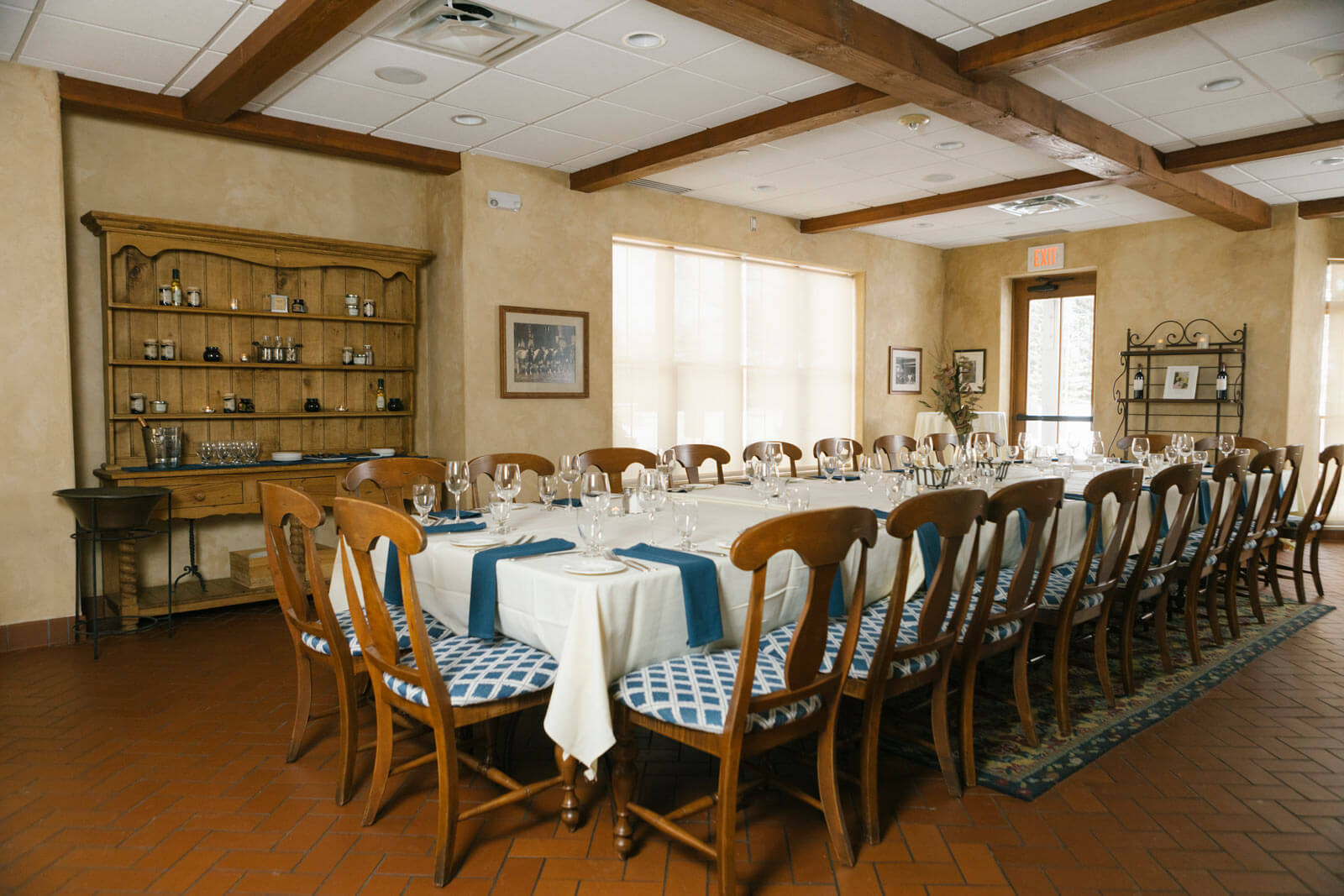
private dining room with set table

By Amanda Baltazar

There are four private dining rooms at Butcher and The Boar in Minneapolis, but none are used exclusively for private dining events. Each can accommodate overflow from the main dining room on busy nights, they can be used for private events, and they can be used for exclusive on-site activations.

Having a private dining room with only one function isn’t feasible for today’s restaurants with high rents and high overheads. It makes more sense to have a room that can be adapted to multiple uses and generate revenue.

Private dining rooms even have in-house uses these days, says Leif Billings, vice president, Northeast, Next Step Design, Annapolis, Md. They might be used for pre-service staff meetings, employee offices or even training and interviews.

Flexibility has become much more important, says Rick Mijares, founder and managing partner of American Social Bar & Kitchen in Fort Lauderdale, Fla., which has five restaurants in Florida, with a sixth coming this year. Needing to be flexible, “wasn’t that way when we started the company 12 years ago, but it’s become a major part of it. You don’t want your restaurant to feel empty and the ability to scale is super important,” he says.
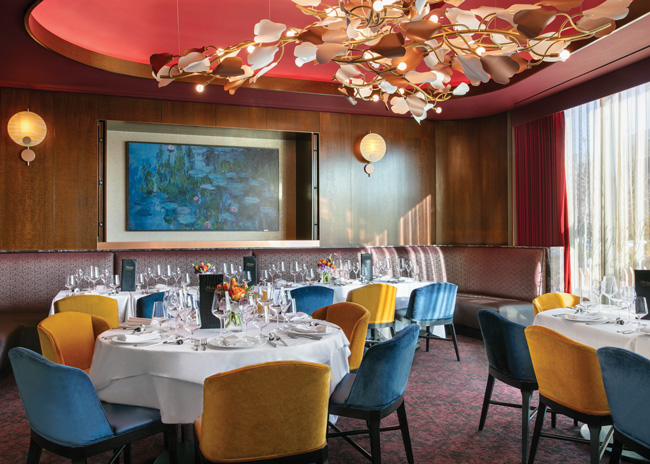
Jula’s private dining is separated from the main dining area by wine storage, but is semi-open. Image courtesy of Joseph Tran

Options for Separation

There are several ways to close off a private dining room but for a room to be truly flexible, it needs to open up or close off quickly and easily. Building in ways to create a semiprivate space is a plus.

Butcher & The Boar’s private dining rooms are separated from the restaurant by different means — a glass enclosure with a shade that can be pulled if a group wants privacy, a sliding wooden door, and a frosted glass door.

Billings likes to use furniture like bookcases or liquor displays on casters or suspended from the ceiling to block off or open private dining rooms, and he says that while curtains are a good way to section off a room on a budget, they can become grimy over time.

Wine storage works well to partially screen off private dining, says Frank Cavanaugh, principal, Aria Group, Oak Park, Ill., who employed that method at The Palmer House in Chicago. Cavanaugh says it looks good from both within and outside the room. Typically, it’s not working wine storage but display bottles, he notes.

David Shove-Brown, partner at Washington D.C.-based architecture and design firm //3877, used wine storage at Jula’s on the Potomac, which themed the private dining room as the Wine Room.

These glass cases create partial walls on either side of the entryway into the private dining room, with the remainder of the space open, yet separated enough to feel distinct.

The St. Paul Grill in St. Paul, Minn., has a private dining room for 10 that evokes a wine cellar experience. It’s separated from the dining room by wine racks and plants so it can be easily opened up.

“You can’t treat these rooms as an afterthought,” says Richard Dobransky, president of Morrissey Hospitality, which owns and operates the restaurant.

Cavanaugh also likes architectural wall systems that come down from the ceiling and disappear when not in use. However, he adds, “you need a lot of structural capacity to hang those.” These doors can be made from just about any material — wood, glass, fabric, or wallcovering, for example.

Glass is a great medium to section off private dining rooms and can be etched or reeded to make a room semiprivate. Of course, curtains or shades can also be used.

Some of American Social’s private dining areas are on patios, which are also used for parties and regular outside dining. Sometimes these are surrounded by roll-down screens with windows and landscaping pots and planters on wagons can create green walls, or if they’re on casters they easily open or section off areas and make them completely private.

At Junction Bakery in Washington, D.C., the private dining room sits at the back, behind folding glass doors. This visibility also makes the room look very intentional, says Shove-Brown, and has the added plus of working as great advertising for the room itself. The room contains a long wooden table that works equally well for private dining or as a communal table. Shove-Brown added fun artwork and lighting “so people want to go in for the communal space,” he says.
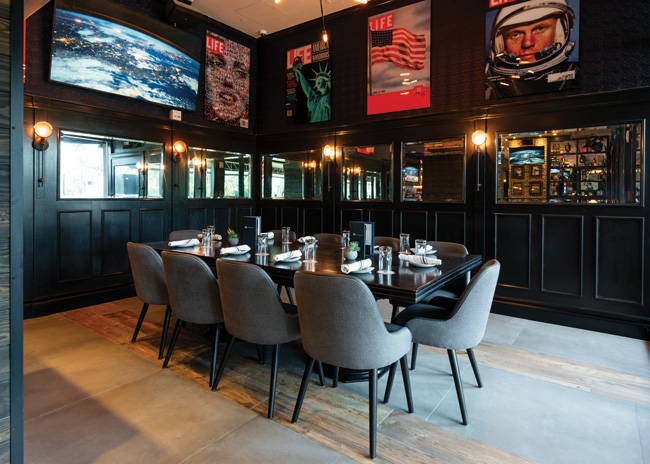
American Social designs more flexibility into its restaurants than ever before, which is essential, says founder Rick Mijares. Image courtesy of American Social

Think Semiprivate

Frank Cavanaugh is seeing private dining rooms have a more passive separation from the main dining area, so they’re within the dining space but separated from it, often by a banquette or shelving or even elevation. “You’re not completely isolated but you have your own private area,” he points out.

Sometimes these dining rooms are differentiated from the main dining space through a couple of steps up, but a challenge to this is that every step up also requires an ADA ramp, which takes up a lot of space. Wildfire in Chicago, owned by Lettuce Entertain You, has a private dining room in the main area, raised up 12 inches.

Here there are some single-hang sashes that fold up and down for sound privacy, Cavanaugh says, but also open to turn this into a part of the main dining room. There are also moveable millwork screens that partially block the area.

Momofuku in Washington, D.C. also has a private dining room a couple of steps up from the main dining area. “It’s separated vertically,” says Shove-Brown. Bookshelves also provide some privacy but still make the area feel part of the restaurant. It feels slightly different to the main dining room with different artwork, so it’s a destination but also fits in when used for regular dining.

Momento in Saint Paul, Minn., has a private dining room that is separated architecturally from the main dining area by a few steps. “You feel like part of the restaurant but part of the VIP experience,” says Dobransky. There’s also a rail that provides some separation around this area, and curtains that can be drawn.

Tre Dita in the St. Regis hotel in Chicago has five private dining rooms, one of which is in a slightly elevated area off the main dining room, screened off with a curtain. “You feel like you’re in the main dining space with the atmosphere but you’re in a slightly elevated and slightly cozy space,” says Louise Lythe, associate director, FF&E design and procurement at David Collins Studio, London, England.
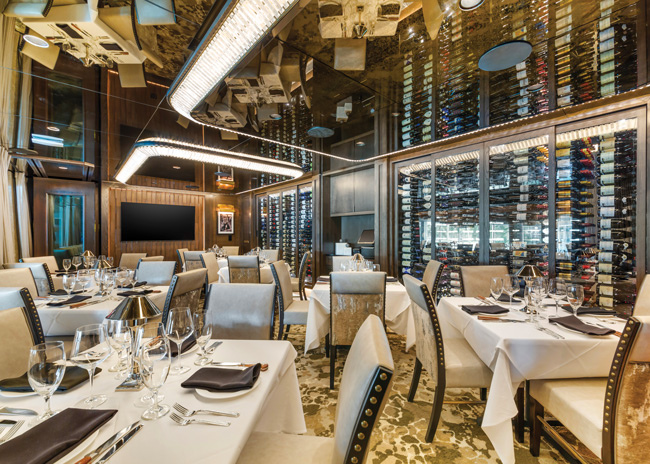
Standout light fixtures differentiate private dining at Maestro’s. Image courtesy of Maestro’s

Add Special Touches

It’s important to have unique and differential dining experiences in private dining, says Cori Kuechenmeister, design director of Shea in Minneapolis. At Butcher & The Boar, she says, “we really spent time making sure each room has its own attitude. The more flexible these rooms are, the more we can help with peak times and slow times, and we can tailor the experience to a rowdy group or a quieter group.”

She made each room distinct. One features a lighter color palette, unique artwork and ultra-plush dining chairs; another has a darker, moodier feel and features a signature table with a metal copper accent running through it; a third has a showpiece light fixture, a lot of glass and sparkle and gold, and different flooring; and one is almost a concept within a concept and feels like a speakeasy lounge with decadent velvet seating.

The different private dining rooms within each American Social restaurant all have their own feel, says Mijares. “We have different artwork, different finishes on the bar like tile, wood, steel, brass accents, antique mirrors. Everything is a bit different, but it blends seamlessly.”

Kellie Sirna, owner and principal, Studio 11 Design, Dallas, likes private dining rooms to flow from the main dining area so they’re not completely different, and elevates them with nice lighting, millwork or special art. “People want exclusivity but still want the energy of what’s going on outside,” she points out.
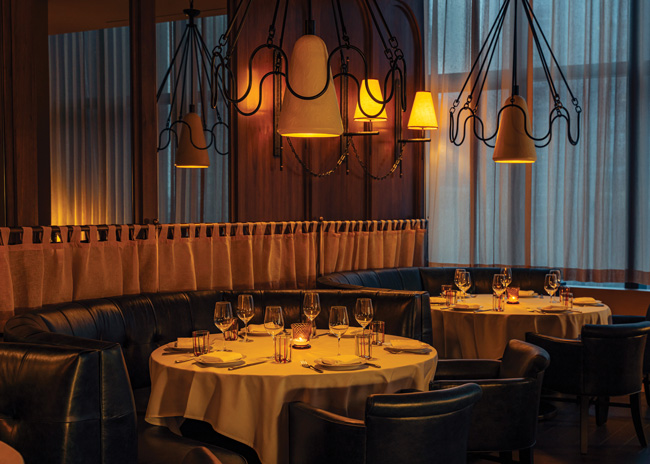
Tre Dita has one private dining room that’s slightly elevated from the main dining area, making it part of the dining room but still separate. Image courtesy of Eric Wolfinger

Include Technology

The addition of technology can make private dining rooms more appealing.

Sirna likes to include as much audiovisual equipment in a private dining room as she can to make it as flexible as possible. She has plugs under all tables for laptops, but they’re not visible when not in use; and she includes TV screens that can be customized with artwork of images to link with a private event.

“Designing it with that programming in mind at the beginning is really important,” Sirna says. “It’s always a win when people can just come and plug in for a presentation.”

Cavanaugh particularly likes to have audiovisual equipment in private dining rooms if they’re in business areas. This can be hidden behind millwork or doors when not in use, but often it blends into the room seamlessly, especially if the TV looks like something else when it’s turned off, like a mirror or a piece of art.

Brian S. Thomas, principal, DP3 Architects, Greenville, S.C. also likes to include audiovisual equipment, and screens that drop down from the ceiling so they can be hidden. “It’s a good selling point for the restaurateur,” he says. “If you can offer that and can integrate it, your design is going to be cleaner, your room will function better, and guests will know they’re in a place where the restaurant knows how to take care of them.”

Refrence: https://rddmag.com/design/4377-how-to-design-private-dining-rooms

Richard Dobransky

President & CEO

Richard joined Morrissey Hospitality as President in 2018 and accepted the role of CEO in 2023. Under Richard’s leadership, the organization implemented best-in-class solutions to support its hotel, restaurant, and events venue portfolio. He spearheaded efforts to upgrade all internal systems, embrace automated workflows and data analysis, and streamline every aspect of the organization for real-time, accurate reporting and accountability.

Focusing next on the employee experience, Richard oversaw a restructuring of employee compensation to ensure that every Morrissey employee earns more than a living wage. With his team, he improved employee benefits packages and ushered in numerous new initiatives to reflect the needs of employees and promote better work-life balance.

Under Richard’s leadership, the Morrissey portfolio has grown from 5 to 18 owned and managed properties. He oversees a team of over 100 managers and 1,000+ employees, leads efforts to provide authentic hospitality experiences at every location, and is an active coach and mentor to many.

Well respected and highly regarded throughout his career, Richard enjoys annual recognition in the Minnesota Top 100 and Top 500 Business Leaders list, and was named among Minneapolis/St. Paul Business Journal’s 2026 Most Admired CEOs. He serves on the Board of Directors for Visit Saint Paul and The Downtown Saint Paul Alliance.

Richard intrinsically understands the communities he serves, helping to create hospitality concepts that serve as long-lasting, meaningful gathering spaces. He aims each day to make, do, and be better for Morrissey customers, employees, clients, partners, vendors, and community members alike.

Elizabeth Morrissey

Senior Vice President

As Senior Vice President and Chief Growth Officer at Morrissey Hospitality, Elizabeth leads the company’s growth strategy with a focus on business development, strategic partnerships, and brand expansion. With nearly a decade of internal leadership experience and deep roots in hospitality, she drives new revenue opportunities, cultivates client relationships, and strengthens the company’s presence in new and existing markets.

Elizabeth began her career at The Saint Paul Hotel before taking on leadership roles at the Waldorf Astoria New York, Johnson Brothers Liquor Company, and Moet Hennessy. She returned to Morrissey Hospitality to help shape the company’s next chapter, progressing quickly from operations into business development. Her background spans hospitality operations, marketing, human resources, and sales strategy — making her uniquely positioned to scale the organization’s impact while preserving our guest-first, people-focused culture.

Elizabeth’s leadership is grounded in purposeful growth: building high-performing teams, elevating client brands, and delivering exceptional service across every property in the Morrissey Hospitality brand portfolio.

Paula Soderberg

Vice President of Human Resources

Paula is a results-driven professional with comprehensive and extensive human resources experience. She is well-versed in labor relations, employee relations, retention, training and development, HRIS, compensation and benefit management, domestic and international recruiting, job description development, HR audits, unemployment hearings, worker’s compensation claim management, and risk and safety management. She is also well versed in Def Leppard — so don’t mention the band unless you want her to talk your ear off.

Paula’s experience helps her foster an optimal working environment through development and deployment of new strategies in recruiting, onboarding, training, job description and standards, benefit administration, and employee development. She is a versatile and motivated leader, with proven communication and organizational skills. She is practical, articulate, and creative with a demonstrated ability to solve difficult issues.

Paula started in hospitality while a teenager at her family’s restaurant in Stillwater, MN. She continued to work FOH positions while in college pursuing her HR degree (don’t ever let her work BOH. She can’t cook…at all.) She understands operations, allowing her to support management and coach employees effectively. She also has held many HR management roles within healthcare, insurance, telecommunications, and government, but hospitality is her home.

Keith Reardon

Vice President

Keith is a hospitality management professional with 30+ years of experience leading food & beverage operations for hotels, restaurants, golf courses, and sports & entertainment facilities. His peers describe him as a high-capacity, intuitive, creative, thoughtful, and disciplined leader. With years of industry knowledge and experience in multifaceted hospitality environments, he routinely demonstrates strength in strategically building high-performance teams, resulting in stable revenues and profits.

Before joining Morrissey Hospitality, Keith held positions with Ritz Carlton Hotels in Palm Springs, before moving on to Centerplate, where he operated the Colorado Convention Center and opened Seattle’s T-Mobile Park. Keith’s passion is restaurant and kitchen design and construction. He recently completed the design and construction of all the hospitality components at Morrissey’s newest location, Tattersall Distillery in River Falls, Wisconsin. Keith is active in the Twin Cities community, serving as Treasurer on the Executive Committee for the Hospitality Minnesota’s Educational Foundations Board, and as an advisor to Visit Saint Paul.

Johnessa Hardyman

Vice President of Finance

Johnessa has always had a passion for finance and accounting. She started her career in community banking and completed her bachelor’s degree in accounting before finding a passion for hospitality in 2012 at The Saint Paul Hotel. Johnessa spent two years working onsite at The Saint Paul Hotel before transitioning to the Morrissey Hospitality Shared Services Office.

Johnessa Hardyman brings over a decade of expertise in hospitality finance to her role as Vice President of Finance at Morrissey Hospitality. Since joining the company in 2012, she has held key leadership positions, including Senior Accountant, Controller, and Director of Financial Planning and Analysis. Johnessa’s extensive experience spans budgeting and forecasting, cash management, internal and external audits, system transitions, and acquisitions.

With a Master of Science in Accountancy from Saint Mary’s University, Johnessa excels at leveraging financial data to drive informed decision-making. She leads the accounting team with a focus on accuracy, efficiency, and strategic planning, ensuring that financial insights translate into actionable business strategies. Passionate about financial forecasting, she thrives on analyzing how businesses actualize their projections and the impact on cash flow. Her deep understanding of both finance and hospitality makes her an invaluable asset to the organization and its clients.

Amy Houston

Vice President of Marketing & Communications

A Professional Certified Marketer (PCM) with a deep passion for hospitality, Amy blends creativity with strategic vision to build meaningful connections between brands and guests. Her expertise in brand development, campaign execution, and revenue-focused marketing continues to shape Morrissey Hospitality’s growth and industry leadership. Known for her empathetic leadership style, she fosters collaboration and inspires those around her to think bigger and work together to bring bold ideas to life.

Amy Houston brings over 20 years of experience in marketing, hospitality, and sales. Since joining Morrissey in 2020, she has led strategy for 18 independent brands, driving measurable success through data-driven campaigns and innovative storytelling. Under her leadership, the company has transformed its marketing operations, bringing services in-house and streamlining digital platforms to create a more cohesive, results-driven approach.

Callie Kiepke

Vice President of Operations

Callie Kiepke is Vice President of Operations for Morrissey Hospitality, bringing more than a decade of leadership experience across event venues, restaurants, and golf course operations. Known for building strong teams and implementing effective, scalable processes, she plays a key role in driving consistent performance across the organization.

Callie began her hospitality career at 18 and earned a degree in Hospitality Management from the University of Wisconsin–Stout. After nearly ten years with TPC Twin Cities, she joined Morrissey Hospitality at Bunker Hills Event Center, where she advanced from Catering Sales Manager to Director of Catering and later General Manager. Under her leadership, Bunker Hills became one of the company’s top-performing properties.

In addition to her work at Bunker Hills and Kendall’s Tavern & Chophouse, Callie has supported operations at Stockyards Tavern & Chophouse, played a key role in the opening of Dawn Manor, and is instrumental in strengthening private dining operations. As Vice President of Operations, she leads menu development, systems strategy, and process standardization, with a focus on continuous improvement and exceptional guest experiences.

Name(Required)
How should we contact you?
Services Needed(Required)
Check all that apply
Tell us about your business needs and purpose for reaching out.

This site is protected by reCAPTCHA and the Google Privacy Policy and Terms of Service apply.